

Few things are more alarming than a Maytag or Whirlpool washer that suddenly sounds like a freight train in your laundry room. Whether it’s a high-pitched squeal during the spin cycle, a rhythmic thumping, or a heavy metal-on-metal grinding, these noises are your machine’s way of signaling a mechanical failure. The good news is that most of these sounds are tied to specific, replaceable parts like suspension rods, drive pulleys, or bearings. This guide will help you “decode” the noise your washer is making and provide the exact steps to silence it before a small rattle turns into a costly replacement.
Why is my Whirlpool/Maytag washer making noise?
What is causing my washer to make loud noises? The cause of a noisy washer depends on the specific sound:
- Banging or Thumping: Usually caused by failed suspension rods or an unbalanced load.
- Grinding: Often indicates a worn-out drive hub or splutch assembly (the parts that engage the spin basket).
- Squealing or Chirping: Typically points to a bad drive belt or a seized pulley.
- Loud Roar (Jet Engine Sound): A classic sign of failed tub bearings. To fix most noises, you will need to inspect the underside of the machine for worn plastic shavings or check the tension of the suspension rods.
If Washer is Making Grinding Noise
If you’re hearing a grinding noise coming from your Whirlpool or Maytag washer, it could be that the gear case or tub bearings have worn out. Besides that, it’s also possible that a wash plate or agitator is also problematic.
Gearcase Has Worn Out
(This applies to front-loading washers only)
What it is: The gearcase or transmission is a crucial part of a front-loading washing machine. This part is responsible for driving the agitator, which loosens up the dirt from any clothes in the washer.

At the same time, it also helps to spin the washer’s basket and either direction as needed during the washing cycle.
Why it fails: The gearcase is one of the most hardworking components in any front-loading Whirlpool or Maytag washer.
This part wears out faster than other parts, and even more so if the machine is under exceptionally heavy use.
Besides that, it’s also possible that the seals around the gearcase could wear out as well, allowing moisture into the gearcase or rubber seal has worn out and speeding up its wear and tear further.
Gear cases run around $200

How to fix: Replacing a worn-out gearcase can be pretty challenging, as it’s attached directly to the back of the drum.
That means the process will include removing access panels on the machine and dismounting the basket as well. Once that’s done, it’ll be much easier to remove the existing gearcase.
Tub Bearings Have Worn Out
What it is: The tub in your Whirlpool or Maytag washer relies on bearings to work correctly.
Those are metal rings that allow the tub to spin smoothly in both directions, especially at higher speeds like during the spin cycle.

Why it fails: Tub bearings, like any other moving washer part, will wear out eventually. You’ll know that’s the case when it sounds like a plane taking off as the tub tries to spin.
Some tub bearings will wear out faster with heavier use, or moisture finds its way to them and causes rusting.
How to fix: Worn out bearings can’t be fixed, so they’ll need to be replaced with new ones.
They’re located in the tub behind the basket, which makes reaching them quite challenging. Replacing tub bearings will require removing the tub entirely from the washer. Once that’s done, the worn-out bearings will be much easier to remove and replace.
Wash Plate Or Agitator Is Problematic
(This applies to front-loading washers only)
What it is: Inside a Whirlpool or Maytag washer tub, you’ll find either a wash plate or agitator. Both of them serve the same purpose: to loosen and shake up any dirt from the fabric that you put into the machine.
Why it fails: Even though the wash plate or agitator might seem like simple components in a washer, they can cause grinding noises if they were to become problematic.
For instance, water could have found its way to the metal parts underneath the wash plate or agitator, leading to rust. That could cause the grinding noises that happen as the tub spins during the washing cycle.
How to fix: Thankfully, replacing a wash plate or agitator is a very straightforward process. You won’t even have to remove any access panels to perform this fix.
These parts are generally held in place with just a bolt. Once you’ve removed the bolt, you can remove the problematic wash plate or agitator and replace it with a new one.
If Washer Is Making Humming or Buzzing Noise
Humming and buzzing noises are also common with Whirlpool and Maytag washers.
They’re typically caused by a jammed drain pump, locked up motor, broken motor coupling, or an inlet valve that’s not receiving any water.
Drain Pump Jammed And Not Draining
What it is: A drain pump only has one task: to help remove all of the water from the washer and push it down the drain pipe.
Why it fails: If your drain pump is humming or buzzing, that means it’s trying to do its job, but something is making that impossible.

Typically, that means the pump is jammed with something stuck inside of it. Therefore it’s unable to drain the washer’s water.
How to fix: The only way to fix this is to inspect the drain pump up close. Then, you’ll be able to identify what’s stuck in the pump and remove it manually. Doing so will allow the drain pump to work normally again.

Locked Up Washer Motor
What it is: The motor is the heart of the washer. It provides the power necessary to spin the washer drum, which agitates the dirt in the clothes and later spins them dry.
Why it fails: Humming or buzzing noises coming from the motor might suggest that something is locking it up.
That means you may have a foreign object stuck between the motor and the belt, which stops it from turning.
How to fix: With the power off, you’ll need to inspect the washer motor up close.
You can do this by looking underneath the washer with a flashlight and looking for anything that’s stuck between the motor and the drive belt.
Remove the object, and everything should go back to working normally again.
Broken Motor Coupling
(Top Loading machine)
What it is: Some Whirlpool and Maytag washers, particularly top-loading ones, rely on a motor coupling.
It connects the motor shaft to the machine’s direct-drive transmission. It channels the power from the motor towards turning the washer drum.
Why it fails: Buzzing or humming noises could be caused by a broken motor coupling, when a motor is spinning without any load.
The coupling typically breaks to protect the motor from damage, particularly when the drive system seizes up for any reason.

How to fix: The motor coupling is attached directly to the motor. So, replacing it will require you to remove the necessary access panels to reach the motor.
Once there, you’ll be able to remove the broken motor coupling and replace it quickly.
Water Inlet Valve Frozen or Not Getting Water
What it is: The water inlet valve controls how much water enters the washer from the water supply.
Once there’s enough water inside, the valve will shut and prevent excess water from flowing in.

Why it fails: Water inlet valves can cause a humming or buzzing noise if there’s no water coming in from the house’s water supply.
Besides that, frozen pipes can also cause a lack of water entering the machine, leading to the humming or buzzing noise you hear.
How to fix: To fix this, check to ensure that your home has a supply and flow of water. As long as there’s water coming through, the water inlet valve will not buzz or hum.
If Washer is Making Squealing Or Squeaking Noise
Squealing or squeaking noises in your Whirlpool or Maytag washer could be caused by a stretched motor belt, something like a coin stuck between the agitator and the drum, or a partially clogged water inlet valve.
Stretched Motor Belt
What it is: The washer motor belt, sometimes called a drive belt, is what transfers the energy from the motor towards turning the washer drum.
Why it fails: Over time, the motor belt can get stretched too much. That’s a part of its normal wear and tear. However, excessive laundry loads in the machine can also cause this to happen faster than usual.

How to fix: Replacing a stretched motor belt will require access to the washer motor.
That means removing the necessary access panels and even the drum to ensure that you can remove the stretched out motor belt and replace it with the new one.
Coin Stuck Between Agitator And Drum
What it is: The agitator sits in the centre of the drum to shake up any dirt from the clothes inside. It’s a separate piece that’s attached to the drum, typically with a bolt.
Why it fails: The agitator and the drum are two separate pieces attached together by a bolt.
Over time, that attachment can get loose, and a foreign object like a coin could get stuck between the both of them.
That could cause squealing or squeaking noises whenever the drum spins.
How to fix: Removing the agitator entirely will allow you to check for any coins or other foreign object stuck underneath it. Once it’s all clear, then you can reattach the agitator and bolt it back in place tightly.
Water Inlet Valve Partially Clogged
(Only happens during the filling stage)
What it is: The water inlet valve controls the flow of water into the washer.
Why it fails: Squeaking, squealing, or even whistling sounds that happen during the filling stage could be caused by a water inlet valve that’s only partially clogged.

Bear in mind that if it was fully clogged, you’d hear a humming or buzzing noise. But a partial clog will cause whistling instead.
How to fix: Fixing this will require a close inspection of the water inlet valve to identify and remove the clog. Washing it clean will also help to loosen up any dust or debris that might be stuck inside.
Maytag Washer Won’t spin
If your Maytag washer won’t spin, it can be frustrating because the spin cycle is essential for removing water from clothes and completing the wash process. The causes differ depending on whether you have a top-loading or front-loading model, but many stem from mechanical or component failures.
🔧 Top-Load Maytag Washer Won’t Spin
- Faulty lid lock
- The washer won’t spin if it thinks the lid is open.
- One of the most common causes.
- Worn transmission clutch
- Prevents the tub from engaging into spin mode.
- Often shows signs of slipping before total failure.
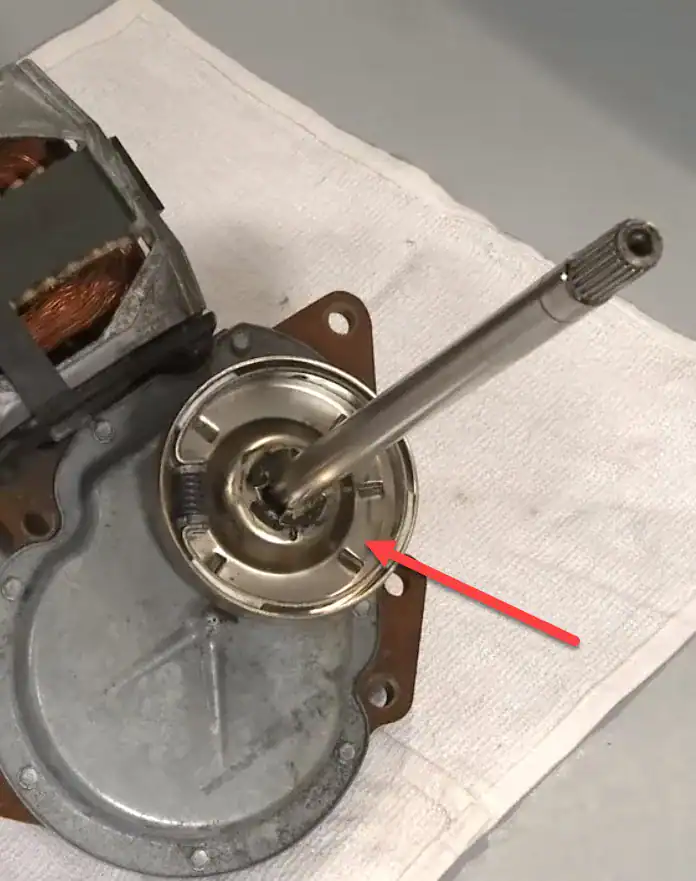
That clutch helps to move the washer’s tub on the inside and the agitator, which removes the dirt from your clothes inside. As the clutch spins, the spring inside will catch on the brake release. With enough tension on that spring, it’ll help to release the washer’s brake and allow the tub to spin.
How to fix: In this situation, you’ll need to replace the transmission clutch. However, it’s not a simple DIY job, so you will probably be better off hiring a professional to do it for you. Typically, the process involves uninstalling the motor entirely. That will make it easier to tip the entire washer over and remove the transmission housing. From there, it’ll be much easier to replace the existing clutch before reinstalling the transmission and the motor.
- Bad actuator switch
- Controls shifting between agitation and spin.
- Failure keeps the washer stuck in wash mode.
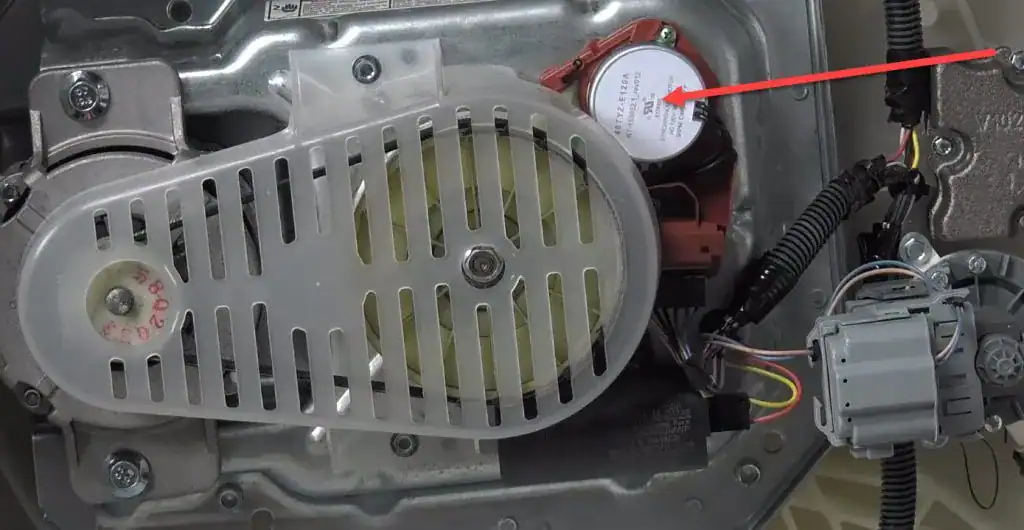
- Worn basket drive hub kit
- Transfers motion from the transmission to the tub.
- If stripped, the tub won’t spin properly.
🚿 Front-Load Maytag Washer Won’t Spin
- Clogged drain filter
- Washer won’t spin if water can’t drain.
- Often an easy DIY fix.
- Failed drain pump
- Prevents water removal, stopping the spin cycle.
- Door lock malfunction
- Spin cycle won’t start unless the door is securely locked.
- Wax motor failure (Neptune models)
- Prevents the washer from detecting a closed door.
⚠️ Key Takeaway
- Drainage issues are common in front-load models.
- Lid/door lock failures are common in both types.
- Some fixes are simple (cleaning a filter), while others require part replacement.
Common Whirlpool & Maytag Washer Error Codes
| Code | What it Means | Quick Fix / DIY Step |
| SUD / Sd | Excess Suds | Run a “Clean Washer” cycle with no soap; use HE detergent only. |
| F5 E1 | Door Switch Error | Ensure the door is fully closed; check for clothing stuck in the latch. |
| F5 E2 | Door Lock Error | Unplug washer for 5 mins to reset the lock; check for a broken latch. |
| F8 E1 | No Water / Low Flow | Check that both hot and cold water faucets are fully turned on. |
| F9 E1 | Long Drain / Clog | Clean the drain pump filter; check the drain hose for kinks. |
| F1 E1 | Control Board Error | Perform a “Hard Reset” by unplugging the unit for 5–10 minutes. |
| F7 E1 | Motor Speed Error | The washer is overloaded. Remove some items and restart the cycle. |
| dL / FdL | Door Lock Failure | The door cannot lock. Check for mechanical obstructions in the strike. |
Connect with an Appliance Repair Tech
Click here to use the chatbox to speak with one of our technicians.
No in-home service calls. No appointments.

I have a Bravosx, MVWX700XL2. Works fine but when it’s off and not running it makes a buzzing noise. We unplug it until we’re ready to use it.
My Maytag top load washer works perfectly until the last 1 minute of the full cycle. It sounds like a grinding pump or drum break. Not sure but this is the only time throughout the entire wash it makes this noise. I have a 30 second video of the noise.
It is a Maytag model: mvwb765fw4
I have a top loading machine that makes an extremely load grinding noise when it tries to spin. It now has also started to wrap my clothes around the agitator. Do I need to replace parts in the agitator, or is it something more?
I need more information about your washer. What the model number?
Possible causes:
1. Drum bearings
2. Position sensor or its wiring
Incoming hot water makes pounding sound and shakes washer, not so with the cold water. What’s wrong?
Partial restriction in the line.
Disconnect water hose from the washer and turn water on. Will it be doing the same thing? If not, then there are possible issues indicated below:
1. Clogged water valve or filter
2. Clogged water hose
My SQ makes a banging noise which becomes worse when spindrying
Is it top-loading or front-loading machine?